Showing posts with label Significant Quotation. Show all posts
Showing posts with label Significant Quotation. Show all posts
Monday, April 30, 2018
Leave the Horse Out of This
I was actually expecting this reading (The Virgin's Lover) to be a lot cringier than it ended up being (as the phrase "romance novel" is one I'm always wary of), but still I did find a couple of cringe moments within it. For example, on page 143, as Elizabeth and Robert admire the portrait of Archduke Ferdinand, Robert makes a peculiar, clearly allegorical and not intended to be skeezy but skeezy (to me) nonetheless about how one ought judge a horses' potential the same way they may a man to marry; in short, feeling it up.
"I would want to know how he felt when I gentled him under my hand, smoothed his neck, touched him everywhere, behind the ears, on the lips, behind the legs. I would want to know how responsive he was when I had him between my legs," (p. 143) and so forth and so on.
My comment, then, is this: I find it interesting, though quite unsettling, that this author, and as we observed in Wednesday's class, many authors' want to sexualize Elizabeth, be it allegorically or directly. I guess a powerful, intelligent woman is just not interesting enough for the masses, though that's human psychology for ya, isn't it? I'm not saying that's how it ought to be, but from reading this, that sure is how it is here.

Tuesday, April 17, 2018
‘Queen’ Elizabeth? Hardly
“Robert, I don’t know how to do this.” she said, in a small voice. “I can’t even remember how to get to the King’s rooms from the great hall. If someone doesn’t walk before me I’ll get lost. I don’t know how to get to the gardens from the picture gallery, or from the stable to my rooms. I... I’m lost here.” (Gregory, Pg. 35)
This quote was the moment I realized there was something very wrong with this novels depiction of Elizabeth. The way she delivers this line- ‘in a small voice’- paints her as helpless and frightened, which is the complete opposite of Queen Elizabeth. We see her here, nervous and quivering and relying on a man to guide her. Granted, it’s in a fairly mundane situation, and it’s entirely possible that the real Elizabeth could plausibly have gotten lost; but I refuse to believe she would openly act so helpless. This is where I realized Elizabeth in this book was going to be nothing but a typical helpless damsel, and it only gets worse from here...
This quote was the moment I realized there was something very wrong with this novels depiction of Elizabeth. The way she delivers this line- ‘in a small voice’- paints her as helpless and frightened, which is the complete opposite of Queen Elizabeth. We see her here, nervous and quivering and relying on a man to guide her. Granted, it’s in a fairly mundane situation, and it’s entirely possible that the real Elizabeth could plausibly have gotten lost; but I refuse to believe she would openly act so helpless. This is where I realized Elizabeth in this book was going to be nothing but a typical helpless damsel, and it only gets worse from here...
Tuesday, April 10, 2018
In Her Own Words...
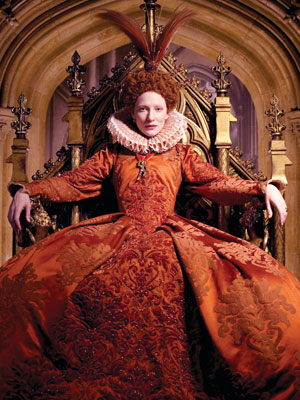
I found several fascinating trends/patterns in Elizabeth's speeches: 1.) She always brings up princes, particularly when referring to herself, 2.) has a teasing tone (seemingly reminiscent of Cate Blanchett's Elizabeth in the film Elizabeth), and 3.) she constantly refers to giving her all to her throne and England, thanking her people for their understanding and effort when she sees fit. These two quotes stuck out to me as great summaries both for her attitude in these speeches and her persona as represented by the other texts we've read/watched:
"How have I governed since my reign? I will be tried by envy itself. I need not to use many words, for my deeds do try me" (Greenblatt, 692).
"I know I have the body but of a weak and feeble woman; but I have the heart and stomach of a king, and of a king of England too" (Greenblatt, 700).
 https://witneyman.files.wordpress.com/2008/02/golden19.jpg
"How have I governed since my reign? I will be tried by envy itself. I need not to use many words, for my deeds do try me" (Greenblatt, 692).
"I know I have the body but of a weak and feeble woman; but I have the heart and stomach of a king, and of a king of England too" (Greenblatt, 700).
Sunday, March 25, 2018
Convinced to kill
"... Men at some time are masters of their fates. The fault, dear Brutus, is not in out stars, But in ourselves, that we are underlings. 'Brutus' and 'Caesar': what should be in that 'Caesar'? Why should that name be sounded more than yours?..." Act 1 Scene 2 Lines 138-142
I Picked this quote to be significant because after a celebration of Caesars military victory, Cassius attempts to persuade Brutus against Caesar. Cassius exclaims that Caesar should not be appreciated more than Brutus and Brutus deserves praise from the people of Rome. Two of the major contributors in Caesars death are plotting against him early in the play.
Monday, February 12, 2018
Long Live Richard, England's Royal King!
BRAKENBURY. Well, madam, and in health. But by your leave, I may not suffer you to visit him. The King hath straitly charged the contrary.
QUEEN ELIZABETH. The King? Why, who's that?
BRAKENBURY. I cry you mercy: I mean the Lord Protector. (Act IV, Scene I, 10-14, p. 69)
In the opening scene of Act IV, Queen Elizabeth along with Lady Anne, Duchess of York and Marquis Dorset request to see Prince Edward and the Duke of York inside the tower. Brakenbury denies their entry at Richard III's request, but by inadvertently referring to Richard III as 'The King' Brakenbury unintentionally exposes Richard III's inevitable ascension to the throne to Queen Elizabeth, the mother of Prince Edward and the Duke of York. At this point Queen Elizabeth realizes the immediate danger that her two sons are in as Richard III's opposition to the crown.

QUEEN ELIZABETH. The King? Why, who's that?
BRAKENBURY. I cry you mercy: I mean the Lord Protector. (Act IV, Scene I, 10-14, p. 69)
In the opening scene of Act IV, Queen Elizabeth along with Lady Anne, Duchess of York and Marquis Dorset request to see Prince Edward and the Duke of York inside the tower. Brakenbury denies their entry at Richard III's request, but by inadvertently referring to Richard III as 'The King' Brakenbury unintentionally exposes Richard III's inevitable ascension to the throne to Queen Elizabeth, the mother of Prince Edward and the Duke of York. At this point Queen Elizabeth realizes the immediate danger that her two sons are in as Richard III's opposition to the crown.
Tuesday, February 6, 2018
Did Shakespeare truly believe the rumor?
"But say, my lord, it were not register'd, / Methinks the truth should live from age to age, /
as 'twere retail'd to all posterity, / even to the general all-ending day." (3.1.75 - 78). I don't think he really believed the rumor that Richard III killed his nephews. It almost seems like, through Prince Edward, Shakespeare is making a point to say that truth should be absolute and not ambiguous. I could be wrong.
as 'twere retail'd to all posterity, / even to the general all-ending day." (3.1.75 - 78). I don't think he really believed the rumor that Richard III killed his nephews. It almost seems like, through Prince Edward, Shakespeare is making a point to say that truth should be absolute and not ambiguous. I could be wrong.
Saturday, February 3, 2018
Richard's character exposed
"Arise, dissembler: though I wish thy death, I will not be the executioner" (1.2.170-171). This quote is said by Lady Anne to Richard III after Richard confesses his "love" to her. He tells her to stab him and she decides not to. I think this is really highlighting and helping us to understand the character of Richard in comparison to the other characters in the play. It also helps us to see what kind of marriage Lady Anne is getting herself into, as well as what kind of character Lady Anne is herself.
Subscribe to:
Posts (Atom)