Showing posts with label Claire Herman. Show all posts
Showing posts with label Claire Herman. Show all posts
Monday, April 30, 2018
Leave the Horse Out of This
I was actually expecting this reading (The Virgin's Lover) to be a lot cringier than it ended up being (as the phrase "romance novel" is one I'm always wary of), but still I did find a couple of cringe moments within it. For example, on page 143, as Elizabeth and Robert admire the portrait of Archduke Ferdinand, Robert makes a peculiar, clearly allegorical and not intended to be skeezy but skeezy (to me) nonetheless about how one ought judge a horses' potential the same way they may a man to marry; in short, feeling it up.
"I would want to know how he felt when I gentled him under my hand, smoothed his neck, touched him everywhere, behind the ears, on the lips, behind the legs. I would want to know how responsive he was when I had him between my legs," (p. 143) and so forth and so on.
My comment, then, is this: I find it interesting, though quite unsettling, that this author, and as we observed in Wednesday's class, many authors' want to sexualize Elizabeth, be it allegorically or directly. I guess a powerful, intelligent woman is just not interesting enough for the masses, though that's human psychology for ya, isn't it? I'm not saying that's how it ought to be, but from reading this, that sure is how it is here.

Monday, April 9, 2018
A More Realistic Take On...
Galloping in an Open Field with Two Athletic Horses Not Specifically Trained to Tolerate Anything Like Film Horses Are: A Fanfiction
(Word-for-word dialogue beginning
at around minute 25) (WHICH ACTUALLY ENDED UP BEING FROM THE SECOND FILM, SO FORGET ABOUT THAT)
Holding on for dear life, Walter
and Elizabeth, intending to have a nice ride out in the open countryside on
their peculiarly identical Friesian horses, began to question their decision to
do so.
“AH!” cried
Walter.
“You have a
stronger horse!” called Elizabeth from a few lengths behind him as his mount
ripped the reins from his hands and ducked into a flat-out gallop.
“Yours
carries a lighter load,” he shouted back, though in turning to do so lost his
balance and tumbled backwards over the horse’s haunches.
In panic
Elizabeth hauled on her horse to slow it and halt. Little to her knowledge her
leg was bruised significantly, as she discovered later, for she had bashed her
thigh on the stiff leather that held her right leg up in the sidesaddle, as she
managed, with a great amount of pulling, to stop. Walter’s horse proceeded to
gallop off back towards the stables, oblivious to the expensive Italian leather
bridle that was torn from his face.
Approaching
her friend on her horse who relentlessly tossed his head in the air and jigged
excessively in anticipation of galloping again, she hissed, “The Queen does not
give way to others.”
“Forgive me Majesty. My horse does not seem to know his place.”
Monday, March 26, 2018
Riddle me this....
Why is it, do you think, that Shakespeare's Julius Caesar begins and stays for an entire scene without Caesar himself, specifically in relation to Richard III? Richard was about as direct as could be as he spoke directly to the audience with a bold monologue, whilst Caesar is only talked about by other people at first.
What does it say about Caesar's character and what Shakespeare's intent was in regard to presenting the characters (Richard III and Caesar)? Consider how it would be as performed in front of a live audience and the affect it would have on them.
P.S.
Seems like a lot to ask, but it's pretty much the same thought; answering one thing helps answer another, I think. I, of course, have my own conclusions on the matter, but I figured since it's a discussion question that I shouldn't write my own answers here...? Eh?
What does it say about Caesar's character and what Shakespeare's intent was in regard to presenting the characters (Richard III and Caesar)? Consider how it would be as performed in front of a live audience and the affect it would have on them.
P.S.
Seems like a lot to ask, but it's pretty much the same thought; answering one thing helps answer another, I think. I, of course, have my own conclusions on the matter, but I figured since it's a discussion question that I shouldn't write my own answers here...? Eh?
Thursday, March 15, 2018
Happy Ides of March, y'all
Found this online and couldn't help but share it here, just for giggles.
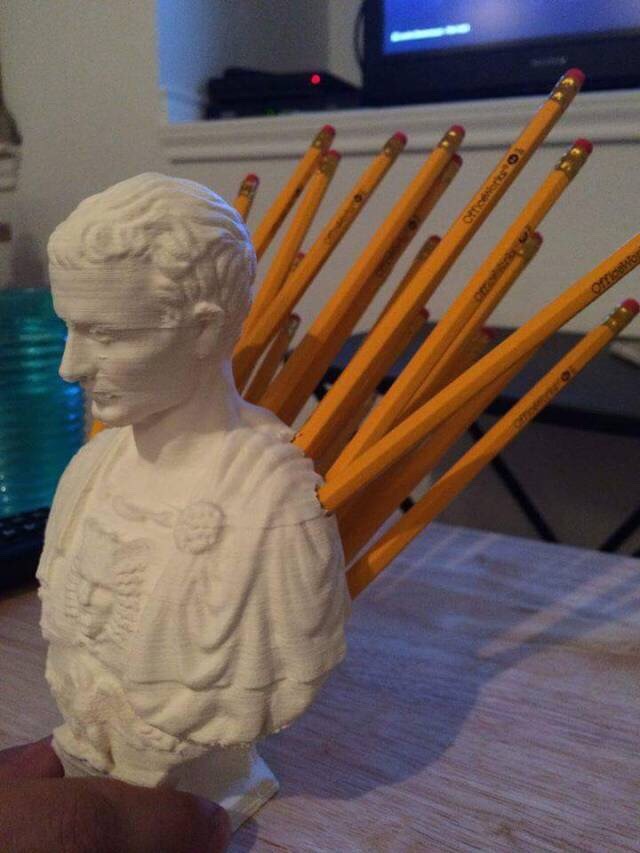
I think I could craft one of these out of clay. Whaddoya say, Doc?
Monday, February 12, 2018
FFS, Rick.
I was struck with an overwhelming sense of "for f*ck's sake" upon coming across the exchange in act IV, scene two regarding Richard’s wish to kill the two boys, specifically lines 20-22: (Richard to Buckingham) “Shall I be plain? I wish the bastards dead, And I would have it suddenly performed. What sayst thou now?”. Which, to me, sounds like “Hey, kill those kids. Ok? Ok.” And when Buckingham offers his hesitations about the matter (lines 26-27: “Give me some little breath, some pause, dear lord, Before I positively speak in this”) Richard says, in short, “Lame. I’ll get someone else that’s not a wuss.”
I find it so outrageously bold and
somewhat comical of Richard, though not completely
out of turn for him, being that the play has sort of been prepping us all along
for his general outrageousness- and I do remind myself that it is indeed a play-
but to me it’s so silly that it takes me out of the moment and makes me
hyperaware that it is really just a
play.
This all brings me to that overarching
theme of this course so far: the embellishment of historical tales and the
degree thereof. We know already that the facts are skewed, but I wonder (my own
disbelief aside) that, if they weren’t, would it or could it have happened so
casually? Clearly, I haven’t the real answer to this, but what I do know is this: there are more layers to this
conundrum than just skewed facts- that is, their depiction that brings people
to be so misinformed. If Shakespeare is going around saying this untrue thing
happened in this absurd manner, then things get extra funky (and not in a good
way).
I
couldn't find an image with quite the right feel to accompany this blog post,
so I made my own.

Created
using imgflip.com, image from television series "The Simpsons"
Sunday, January 28, 2018
An Embellished Historical Figure: The Psychedelic Progressive Rock Way
On the case of Richard III and how he is approached in The Daughter of Time, I am reminded, as I often am, of a Pink Floyd song; "Corporal Clegg". Without writing an essay on the song itself (although I would love to), I'll condense my reasoning to this: the corporal in question, to the knowledge of anyone outside of Roger Waters' head, is loosely based on Waters' father, but embellished and made more appropriate for the song at hand (goofy and off-beat, that is). Clearly the situation is dissimilar (Grant and Richard III vs. Pink Floyd fans and this song) but the parallels are there- different levels of embellishment for different purposes.
Pink Floyd - "Corporal Clegg", A Saucerful of Secrets (1968)
Subscribe to:
Posts (Atom)